
We have been alerted to the possibility of "counterfeit" Weymann instruments being sold, bearing our tradename. All buyers or prospective buyers should have confidence in their transaction!
Reverb Exclusive Items: The majority of our hardware including: SPS Tuner & Swoop Bridge are marketed exclusively on Reverb. Additionally, Reverb is the primary source for the Artist Pro and Model A. If you are buying second hand - you are welcomed to confirm with us prior to completing your sale! The most secure method: Sign up to Reverb.com - and reach our tech support directly through any item. Or simply fill out the form below!
Est. 1864
Philadelphia, Pennsylvania
United States of America
Weymann Musical Instrument Company
Remains one of the nation's oldest and most coveted musical instrument brands.
Rise and innovation:
Weymann and Son was founded by Heinrich "Harry / H.A." Arnold Weymann (Wegmann) in "The City of Brotherly Love" - - Philadelphia, in 1864. The store began as a general retail shop that sold practically anything of value. H.A. would import finely crafted instruments from his native Germany, and would go on to develop a small in-house manufacturing team by 1890. In 1892, son Harry would transform the business into a thriving, full-scale manufacturing operation with a sole emphasis on musical instruments. A pivotal moment occurred in 1899 when Weymann bought the entire warehouse supply from the recently shuttered S. S. Stewart banjo factory, further enhancing their instrument production.
Acoustic innovation:
During 1900-1910, Weymann would develop and patent the first "jumbo" body acoustic guitar—a design that delivered a powerful & resonant sound. This was an important development, as stringed instruments (guitars) were often drowned out by a bands horns, brass & piano. The Weymann Jumbo was produced nearly two decades before any other manufacturer. During the 1920's & 1930's, the company's manufacturing would find great success. Weymann would go on to produce both "highest grade" lines along with finely crafted "Keystone State" instruments, which were sold at a slightly discounted price. Both lines are highly regarded by collectors today.
Artist collaborations:
In 1928, Weymann built a custom guitar for country music pioneer Jimmie Rodgers, which influenced a signature "Special" edition. Jimmie, who is considered the father of modern Country music, would go on to perform with his Weymann until his passing in 1933.
Bumps in the market:
The stock market crash of 1929 and the death of Harry Weymann in 1930 would facilitate considerable challenges for the company. Instrument sales plummeted, and the company struggled to stay afloat. By 1933, in-house manufacturing was reduced significantly. The center city retail shops would continue operating up into the late 60's, along with general distribution for other manufacturers. Weymann's manufacturing however, would wind down to near full-stop; surplus inventory was parked into varying warehouses owned by the family/shareholders.
Modern revival:
While most businesses are forced to liquidate their inventory or declare bankruptcy, Weymann understood the importance & pathway for legacy preservation. With great thought & planning, the estate would preserve the warehouse surplus for a future chapter;
time & date unknown. With great pride, Weymann American manufacturing has reconvened at record pace & well-deserved notoriety.
Revolutionary creations:
Modern Weymann products have been released in very limited quantities and are of the highest quality. Several items are "Reverb" Exclusive's, and almost every part & component is made exclusively in the USA.
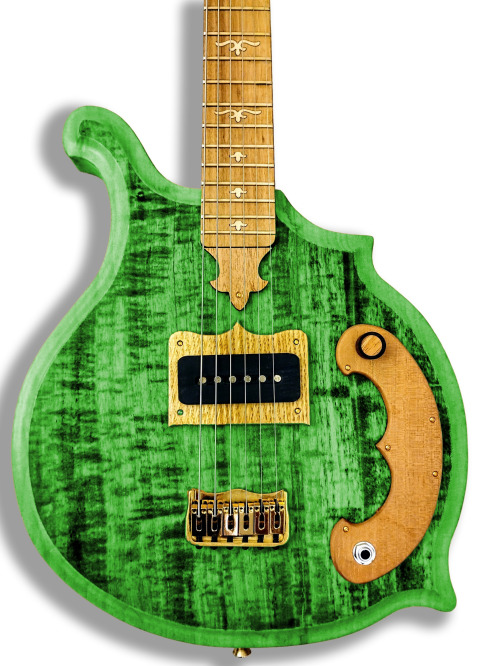
Weymann's current instrument line includes the Solid Body "Model A", "Model B", "Artist" and "Artist Pro", along with several limited-edition hardware items. The instruments have been constructed utilizing archival, surplus material, connecting the brand's
past and present.
Private Vault Prototypes:
Limited "Prototype" models can be found for several models including:
Model A, Model B, Model C & E garnishing great attention from collectors & players alike.
Today, Weymann exists as both a collectible vintage brand and a modern, boutique grade instrument manufacturer. The contemporary instruments pay homage to the company's history while catering to a new generation of musicians and collectors.
(Reverb Exclusive)
Weymann Model A:
The Weymann Model A, is a solid body electric guitar, with a comfortable & familiar 25.5" scale. Made in the USA & created from the overstock, oversized Weymann Mandolute/Mandolin body blanks; the Model A is a unique instrument with elegant appointments. With a total production run of 100, the Model A has been well received by both modern & vintage enthusiasts.
Weymann Model A, Model B & Model C Prototype:
The Model A was developed thanks to its predecessor: the Model A Prototype. The Prototype was subject to a total production of 24 instruments before the final version met production approval. The Model A Prototype is by far - one of the most significant instruments in the annals of guitar evolution. Undoubtedly, one of the rarest. Had the instrument been successfully released during the late 1930's, early 1940's as intended, it would have earned the ranks as the world's first electric (solid body) instrument. Yet, we gladly tip our hats to P.A. Bigsby where credit is due!
Patents & Designs:
Mandolute (Patent No. 43,684): Patented in 1913, the Mandolute was a cross between a lute and a mandolin. It was a commercial success and was heavily produced in the 1910s and early 1920s.
Stringed Musical Instrument (Patent No. 1,215,598): Patented in 1917, this invention, applied to banjo-mandolins, allowed for the adjustment of the string height above the fretboard to suit the player's preference.
Banjo Attachment (Patent No. 1,312,882): Patented in 1919, this patent was for a removable resonator box for banjos.
Tuning Peg (Patent No. 1,554,772): A patent for a variable geared tuning machine head was granted in 1925.
Tailpiece for Stringed Musical Instruments (Patent No. 1,615,152): This patent was issued in 1927.